MonitoringHub.
A cloud-based, web and mobile video monitoring SaaS that integrates cameras with intrusion, access control, and fire systems, then layers alerts, device health, reports, and a built-in configurator on top.
Cloud-based monitoring. A subscription business.
MonitoringHub was a business-model decision before it was a product brief. The company earned mainly from projects: large, infrequent, with five-to-six month sales cycles, each one a well you dig, drink from, and watch run dry before digging the next. The Dashboard had already added recurring income, but only from enterprise clients.
During a leadership session in the COVID lockdown, with the new owners pushing for continuous growth, I made the case for a subscription business. The framing landed, and the model shift was approved in that meeting. The product that executed it took fourteen months to reach first release, and by my departure it was earning ₹7–8L a month from a market the company had never sold to.
Two proposals came from me in that session. The first, a daily-essentials subscription for bread, milk, and eggs, was dropped collectively as outside the company's domain. The second, a mobile-first freemium surveillance app, carried a rough case: up to 100,000 downloads in one to two years, roughly a tenth converting to paid at around ₹500 a month, with the lockdown pushing owners to watch their premises from a phone. That idea became the seed; the collective reshaped it into a web-first product, paid from day one.
The framing that won the room
The new owners had come from outside technology. A spreadsheet would not have moved them; a picture they could repeat to one another did. Winning a business-model decision is often a problem of language before it is a problem of logic.
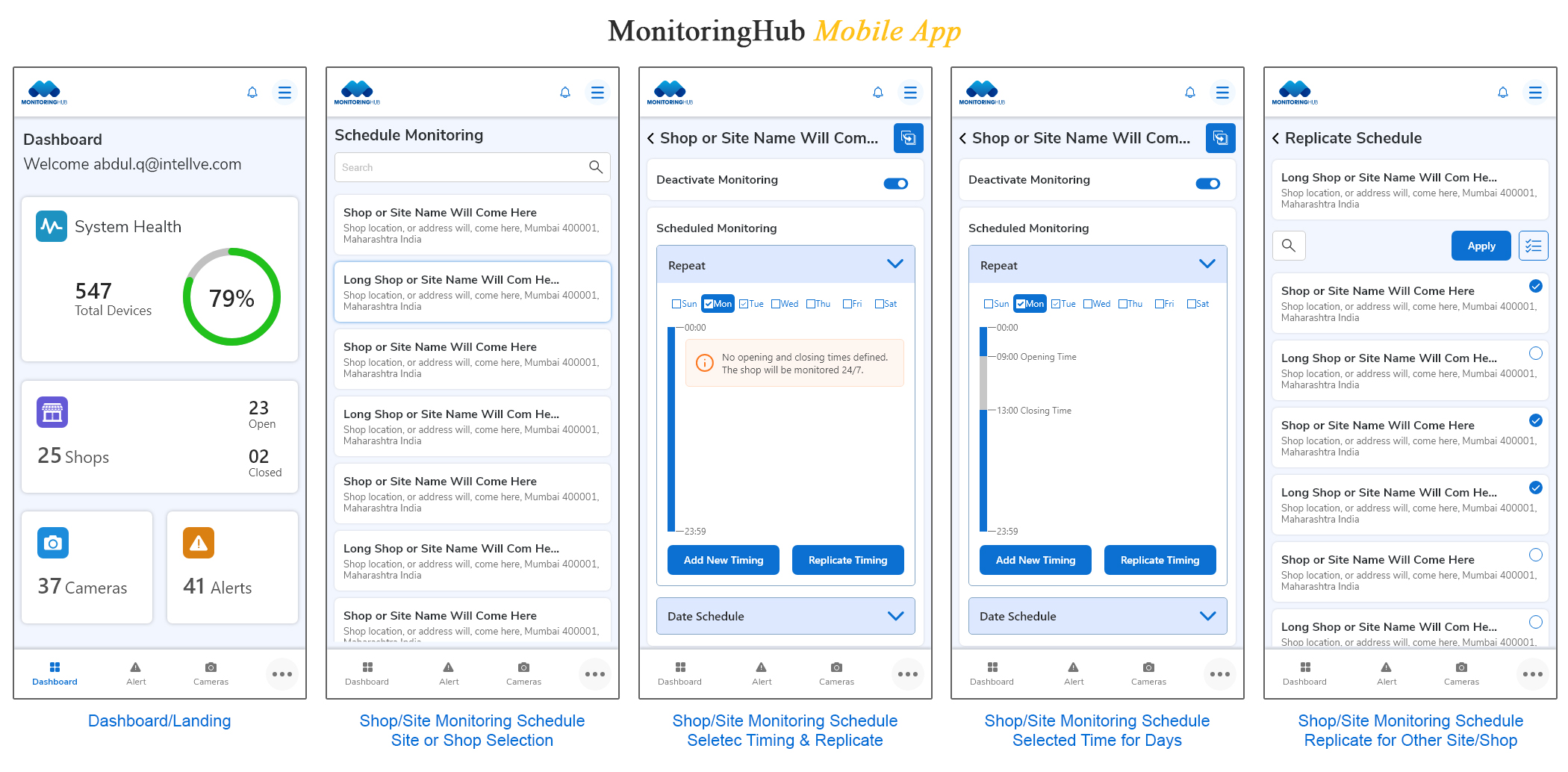
The same platform a control room runs on the web is what a single owner carries on a phone: system health, device and site counts, and per-shop monitoring schedules. One product, every screen size.
Forensic by habit.
I did this research myself, on weekends, while the lockdown held: jewellery shops, medical and liquor stores, schools, cooperative housing societies, roadside stalls. I went to the people the product would serve, in the places they ran their businesses, and I watched what they did rather than recording what they said.
What they did was forensic. Cameras were for reviewing footage after an incident, not for watching live, so the product's real value was never monitoring; it was peace of mind, the restoration of sleep. That insight later shaped my contribution to SecureMyShop, the 2024 retail offering built on MonitoringHub, where the pricing made the same point: ₹85 a day sits beside chai and transport, expenses already accepted, while ₹2,500 a month gets measured against rent. Same money, a different decision. Pricing is UX.
Of the many findings, one became a feature. Owners were quietly afraid of losing footage, so I proposed video backup; management made it a paid add-on, with short retention free and longer retention charged. A fear in the field became a line of revenue.
Shop owners review footage after the fact rather than watch live; the real pain is the mental load of being responsible for a place around the clock. So the product sells peace of mind, not surveillance: the restoration of sleep.
What the field showed
Forensic by habit
Owners reached for the cameras after a theft or any incident, to review what happened, not to watch in real time. They were running a business, not sitting at a monitor. For this segment the product could not honestly be sold as live monitoring.
Vigilance fatigue
Nobody can watch a feed all day; attention decays within minutes, a known vigilance decrement. The real burden was the mental load of being responsible for a place around the clock. Some owners ran dead cameras with blinking LEDs purely as deterrents, proof that perceived surveillance works on perception alone.
One-time over monthly
Asked whether one app for every brand was worth paying for, owners shrugged: they were fine juggling several. A few thousand once they might consider, but a monthly fee was not on their mind at all, even with cloud backup added. A one-time spend reads as a purchase; a recurring fee is a loss felt every month: mental accounting.
Behaviour over claims
Many owners said yes from social agreeableness in front of a researcher, not real intent, a textbook social-desirability bias. As a psychology student I recognised the pattern: stated adoption could not be trusted; observed behaviour and unprompted complaints were the only reliable signal.
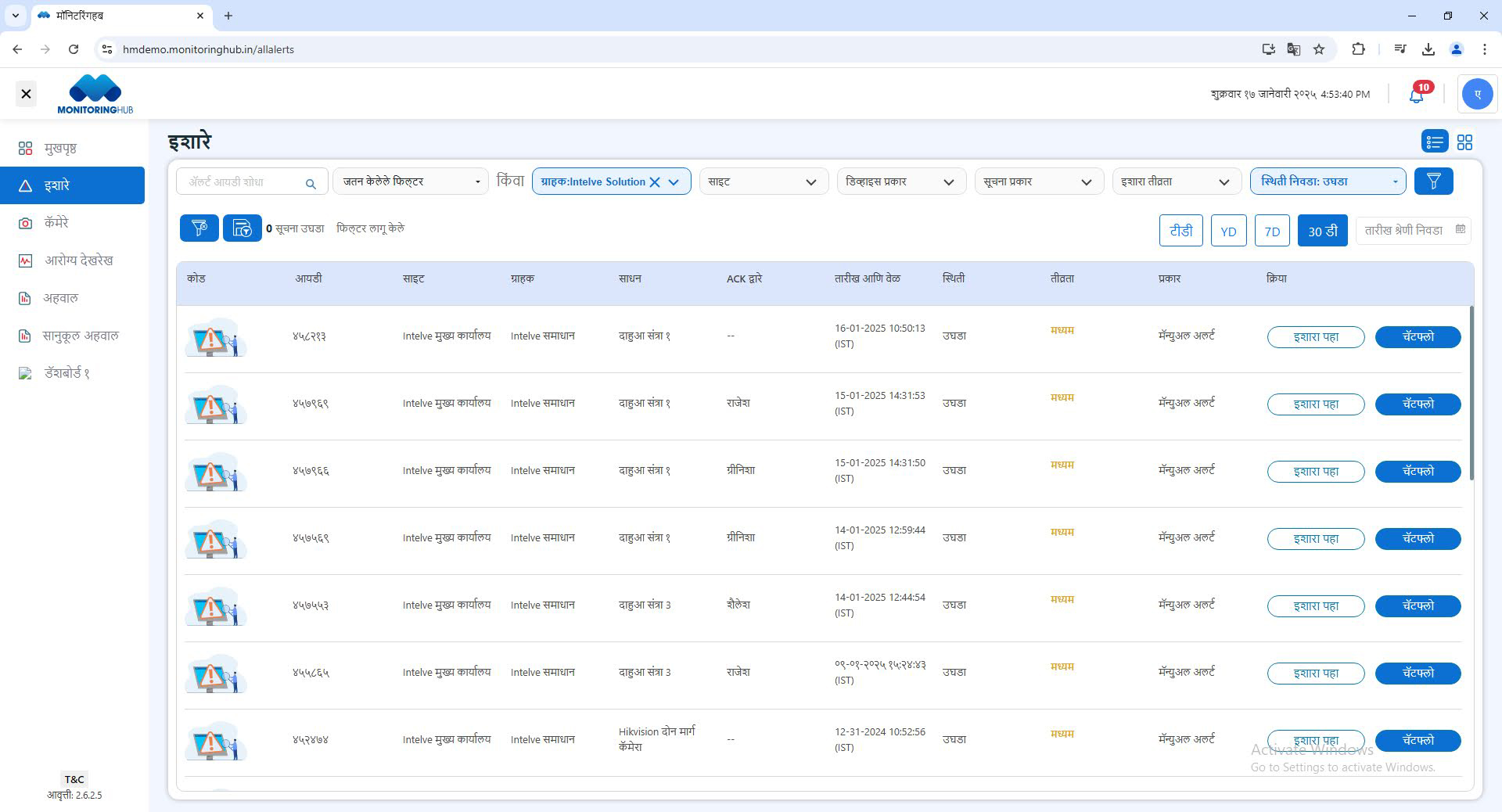
Once the product was built, I tested it the same way I'd researched it, by watching. I put MonitoringHub in front of a man from our office front desk, no product background, no English, only Marathi and Hindi, with nothing but the browser's translation, no manual and no training. He moved through every module and explained the camera and alert pages back to me accurately, asking only a handful of questions. The information architecture and the labels carried the product on their own, with no one in the room to guide him: the clearest proof I had that the structure, not the training, was doing the work.

The screen he used: MonitoringHub rendered in Marathi by the browser alone, a language it was never designed for. He navigated it anyway. Good structure survives translation.
Mobile proposed. Web shipped.
My pitch had been mobile-first, a freemium app on the device customers already carried. The collective call moved it to web-first, and it was the right one: a web app served mobile browsers and desktops at once, reaching enterprise clients, SI partners, and schools alongside the small owners on their phones. A native app would have shut the desktop use case out at launch.
The build
An external design agency was brought in for the initial screens under deadline pressure. Several of us, including me, put forward references; the CEO made the selection. Once the agency was introduced, the engagement was mine: I briefed them on the full picture, the features, user flows, field research, and workflows, then coordinated and reviewed everything they produced, 72 screens with a colour palette and a type specification. An agency can produce screens; it cannot absorb an operational domain fast enough to make informed UX calls. So my team, front-end developers and a graphic designer, built the complete design system from that starting point: typography, icons, spacing, components, interaction states, and both light and dark themes, the first product in the ecosystem designed for both modes from day one. When a beta client later said the agency's mid-tone blue did not look fresh, I did not argue it either: I built corrected prototypes of five key pages in a lighter palette, put them in front of management and the client, and the lighter palette shipped.
What shipped
A browser-based, multi-tenant platform with mobile apps on Flutter, pulling cameras, intrusion, access control, fire, and analytics into one place: up to 49 cameras in a single live view, configurable dashboards and reports, video backup, and onboarding that paired self-service with a human setup call. The live view unified any camera brand in one mosaic and flagged offline cameras in place rather than leaving a blank tile, the layout proven in ThinClient and rebuilt for the browser by the team.
Carried from TouchConfig
The virtualised pagination logic from TouchConfig went directly into MonitoringHub. The filter I redesigned: TouchConfig's drag-and-drop became a clickable element system that fixed its level-ordering limitation. A pattern set for one product in 2018 was still serving performance in MonitoringHub in 2023. Architectural authority is durable.
Leadership signal
Three choices, one product.

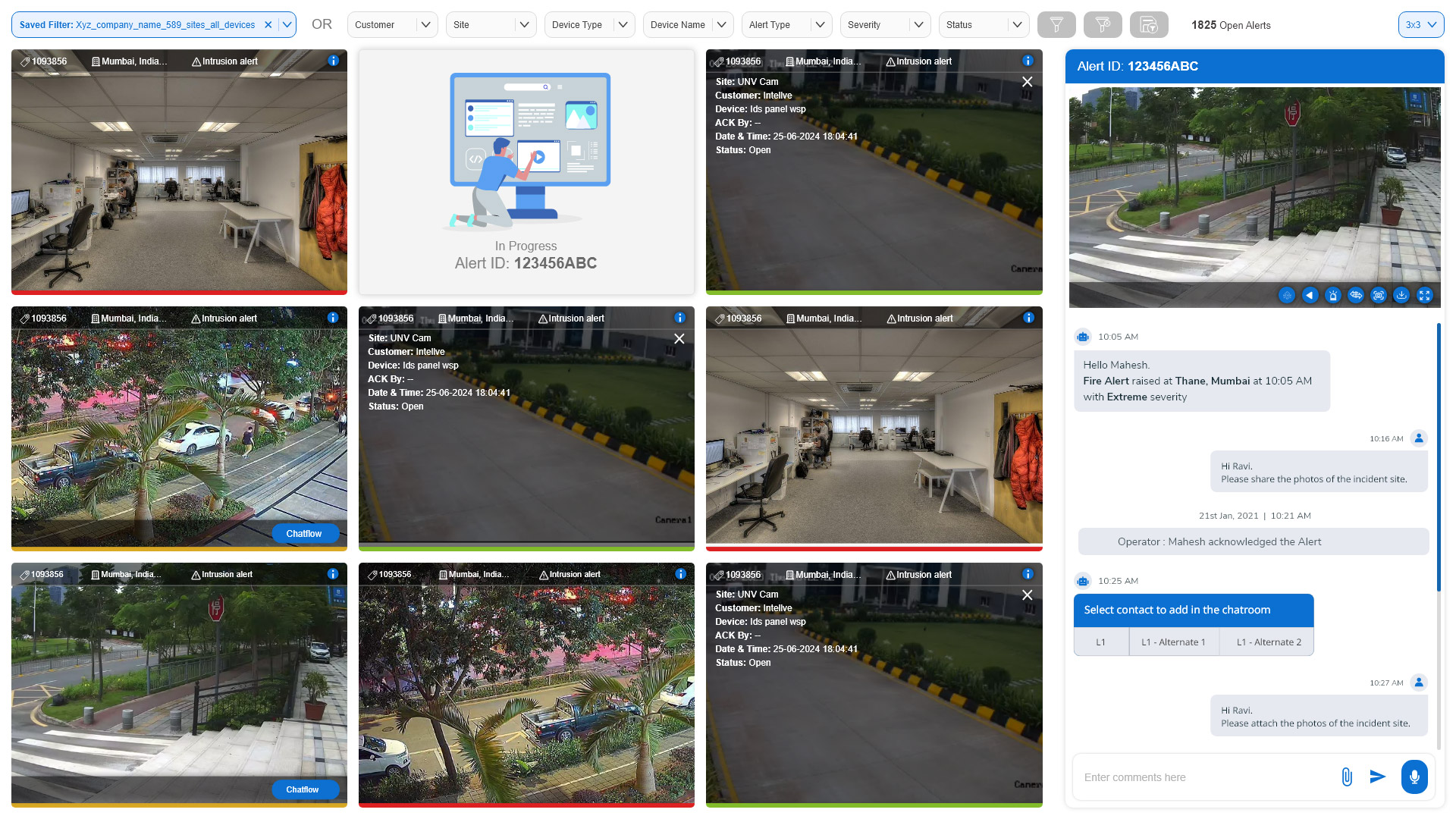
An alert opens its cameras, its detail, and a response chat in one place. The operator works the incident and pulls in the right people without leaving the screen. The whole response lives in a single view.
New business line. New market.
The Dashboard deepened revenue from clients the company already had. MonitoringHub opened a market the company had never sold to: small shops, schools, and cooperative societies, reached through a network of SI partners, each a distribution channel the company did not have to staff.
Built to outlast the builder
Every new subscriber and every SI partner reselling it adds to a base that pays month after month, in a segment the company had never sold to. It was ₹7–8L a month with no proportional sales effort behind it when I left. The real test of how something is built is what happens after the builder leaves: this one runs on a single person maintaining it, and it has earned more, not less, since I did.
Bootstrapped. Still running.
A startup raised $12.2 million from institutional investors to chase the same end-user security market. It reportedly scaled down by 2024–25.
Intellve never took outside capital. It built its products on its own revenue, several of which I originated or shaped, MonitoringHub among them, and they were still running and earning when I left, and after. That durability was not luck: it came from careful unit economics and the kind of real domain knowledge I spent a decade building into the products. In this market, that outlasted growth-at-all-costs.
On the record.
Scattered plant surveillance consolidated into one cloud view for centralised quality-control monitoring.
Cameras across campuses brought under constant health monitoring, with rolling video backup so no incident went unrecorded.
Cameras and intrusion panels integrated into a single command centre for banking clients.
Strongest product validation
The clients hardest to win chose the cloud product over the flagship they already owned: the clearest sign MonitoringHub stood up at the demanding end of the market, not only the small businesses and societies it had opened. That is the one validation a vendor cannot manufacture.
Before and after.
The limits I worked inside.
The freemium tier I let go.
My original pitch was mobile-first and freemium. The collective call reshaped it on two counts: web-first over app-first, and paid from day zero over a free tier. The web-first move was the right one and I back it as a decision; letting the free entry tier go is the part I accepted too easily.
The trade-off was the acquisition funnel a free tier builds over time, the low-friction entry that converts to paid later. Paid-only suited a bootstrapped product; the lesson I keep is that "right for now" and "right for growth" are different cases, and the second is worth arguing for explicitly rather than letting it pass.
Self-service setup never finished.
The human onboarding call was right at launch, but it was meant to be a bridge. Device auto-discovery, the self-service camera setup that would have removed the call, was technically complex for browser-based discovery and stayed deprioritised through to my departure.
So onboarding leaned on the call longer than it should have. The lesson is that a deliberate bridge needs its replacement scheduled, or the bridge quietly becomes the permanent design.
The agency chosen on cost.
The implementation agency was selected on cost and convenience, a call that was not mine to make, and the domain-knowledge gap was predictable and confirmed quickly.
An internal hire over the same period might have produced better foundational output. Where I had no authority over the decision, what I could control was insulating the design and the architecture from it, and that is where I put the effort.
Alert management, the most iterated component.
Alert management took three structural approaches across three years, each transition driven by real operator behaviour at scale, not by a design assumption that held.
The iteration was necessary; the cost was time and change management across an active user base. The lesson I keep is that for the component a whole product turns on, you design for re-architecture from the start, because you will be back inside it.
The work that wasn't design.
Three moments where the contribution was leadership, not design.
I made the business-model case, and won it, in one session.
The wells-and-rivers framing wasn't a product proposal, it was a business-model proposal, put as a picture an executive could repeat. The product followed the framing. Most designers articulate features; this argued a model.
I did the field research myself, on weekends.
Not delegated. Not scheduled around management's calendar. The product's positioning, "the restoration of sleep", came from talking to shopkeepers in their shops, not from a workshop. Leaders go to the work.
I accepted the room's decision over my own pitch.
Mobile-first was my pitch. Web-first was the collective decision and the right one: one build reaching mobile and desktop at once. Knowing when not to fight is a leadership signal.